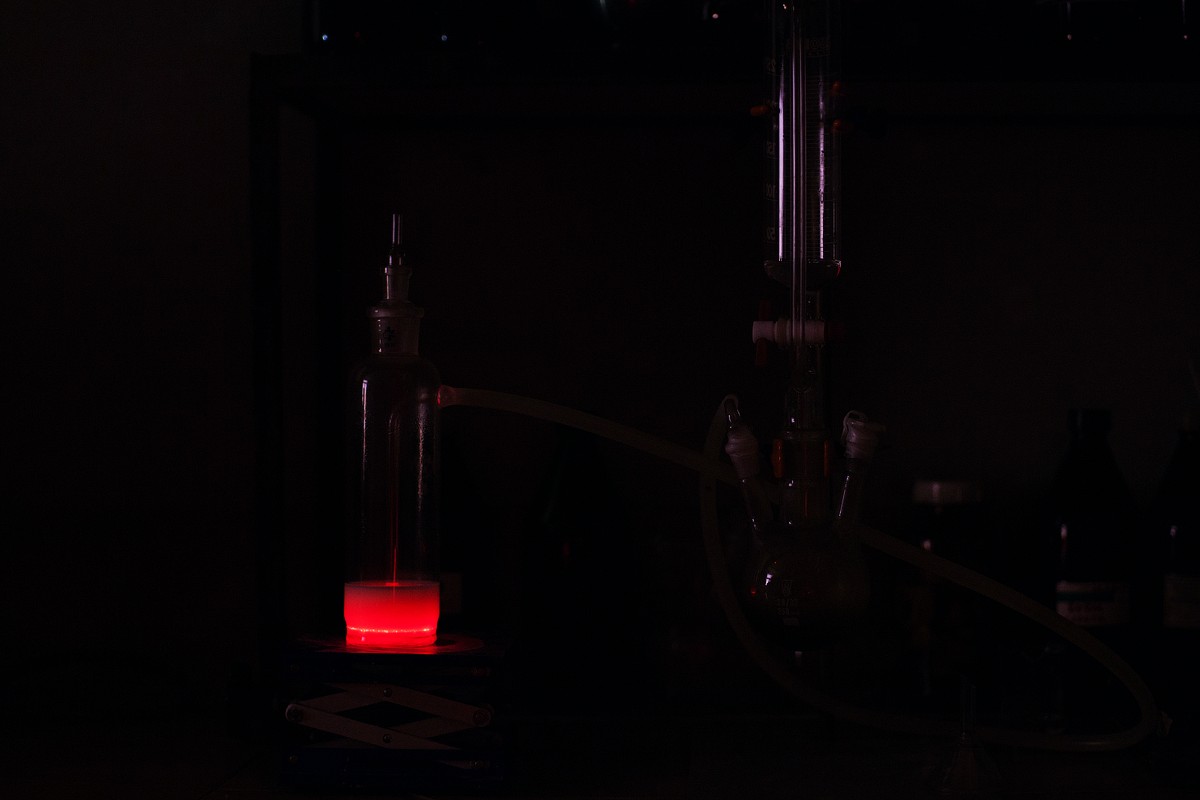
Don’t believe that an atmospheric-dwelling and life-giving gas can disinter hues from the underworld!? Just watch pool chlorine and hydrogen peroxide mix!
Today, I’m sharing the story of a straightforward yet breathtaking scientific experiment I conducted, which lies at the interface between chemistry and quantum mechanics: the chemiluminescence of singlet oxygen.
Summarised Reaction
Anything that glows is magical. No matter how omnipresent light is in our lives, it never ceases to fascinate our human curiosity. Consequently, if I combine it with chemistry in a fun reaction, then I’ll always be eager to try it out.
The simplicity of this reaction that gave bright red light enticed me: I only needed trichloroisocyanuric acid (TCCA, its abbreviation, (CONCl)3, its formula) and 30% hydrogen peroxide (H2O2) to produce chemiluminescent singlet oxygen. TCCA can be found in many supermarkets as a pool cleaner. 30% Hydrogen peroxide can only be found in authorised laboratories, due to its danger as a strong oxidant.
Trichloroisocyanuric acid reacts with water to give cyanuric acid ((CNOH)3) and hypochlorous acid (HOCl).

Then, the hypochlorous acid dissociates to give the hypochlorite ion (–OCl), which reacts with hydrogen peroxide to produce singlet oxygen (1O2). Chlorine gas arises from a few other reactions that aren’t relevant to the production of singlet oxygen.
H2O2 (aq) + ClO– (aq) → Cl– (aq) + H2O (l) + 1O2 (g)
Trying it out
My friend Máximo and I gathered both compounds and devised a perfect setup. As very toxic (used in WW1) chlorine (Cl2) gas is released, a fume hood is sine qua non for living on to learn more chemistry.

We covered the fume hood with posters to make it as dark as possible. We then made a hole in the posters to manoeuvre a beaker containing TCCA, allowing us to drop it into the hydrogen peroxide without having to open the fume hood, which would let ambient light in (and put our lives at risk, which might be more valuable than achieving pitch darkness).
We set up the filming equipment and started the reaction. In the first trial, attempting to neutralise the chlorine gas with sodium hydroxide (NaOH), the solution splattered everywhere and left corrosion stains (still present today) on my computer, so we switched to a protected phone camera for filming. Here is a video of our beautiful production of chemiluminescent singlet oxygen.
Scientific explanation of singlet oxygen chemiluminescence
Gas from the heavens
Oxygen is one of the most essential elements for life, and is the third most abundant element in the universe. At standard temperature and pressure (273.15 K and 105 Pa), oxygen generally exists as the allotrope dioxygen (O2).

The ground (most stable, low energy) state of dioxygen is the spin triplet state, denoted 3Σg–. The image below shows the molecular orbital diagram for this spin state.

What is characteristic of triplet oxygen is that the two non-bonding electrons of the molecule are each in a different antibonding π orbital (one in πx* and one in πy*) and have the same spin (represented with arrow direction), conferring extra stability.
As a consequence of the aligned spins, triplet oxygen is paramagnetic (forms internal, induced magnetic fields in the direction of the applied magnetic field), as can be seen in the image below.

Singlet state
The other spin state oxygen can exist in that is relevant to this experiment is the lowest excited singlet state, denoted 1Δg, which is higher in energy than the triplet state, 3Σg–. When oxygen is in its singlet state, it will react much more readily with other singlet molecules than when it’s in the triplet state.
In 1Δg, the two aforementioned non-bonding electrons are in the same antibonding π orbital (either πx* or πy*), and hence have opposite spins, following the Pauli exclusion principle.

Quantum mechanics in your face!
When two molecules of singlet oxygen collide, they “deactivate” by exchanging their non-bonding electrons, producing two molecules of triplet oxygen (two molecules of 3O2) and LIGHT, due to the energy difference between singlet and triplet oxygen. In the image caption, there is a link to a video which explains it really well.

1O2(↑↓) + 1O2(↑↓) → 3O2(↑↑) + 3O2(↓↓) + 188580 J mol-1
Above, 1O2 and 3O2 represent singlet and triplet oxygen, respectively. The arrows show the spins of the electrons in the antibonding pi orbitals.
This chemiluminescent process is known as dimol emission. The reason why two molecules of singlet oxygen are needed to collide and exchange electrons is that the non-bonding electrons in each molecule of singlet oxygen CANNOT change their spin to occupy the other antibonding pi orbital, as is the configuration in the triplet state.
Using Plack’s equation, we can deduce the wavelength (λ) of the emitted light knowing the energy released (E), Planck’s constant (h) and the speed of light (c).
The energy difference between triplet oxygen, 3Σg–, and singlet oxygen, 1Δg, is 94290 J mol-1. As two molecules (not moles!) of singlet oxygen are combined to form two molecules of triplet oxygen, we must first divide the energy by Avogadro’s number (6.02·1023 mol-1) and then multiply by 2 giving a total release of 3.13·10-19 J per collision. Multiplying Planck’s constant times the speed of light and dividing by the energy provides the wavelength in metres, so it is multiplied by 109 to convert it to nanometres.

The emitted light, with a wavelength of around 634nm, corresponds to the red part of the visible light spectrum, which is precisely how we observe it in the experiment.

Again… a testament to the incredible power of Science!
Leave a Reply