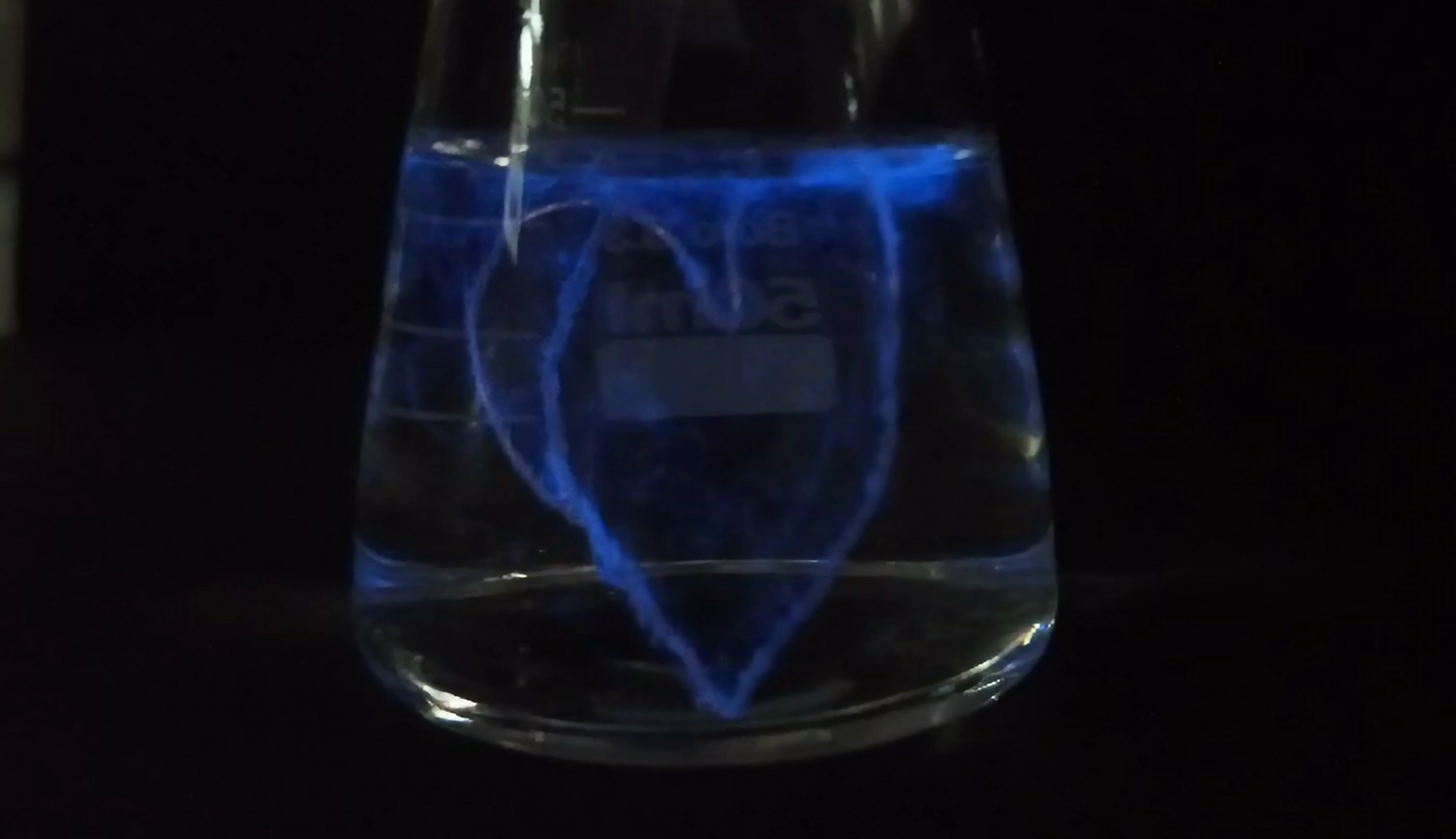
A bit of love turns the darkest depths of sadness into a sea of light
Who said romance is reserved for fancy restaurants? A true scientist at heart pursues knowledge out of love, out of passion for learning about nature. What better gift to enamour someone with scientific awe than this romantic reaction?
Luminol’s a snitch
Luminol (C8H7N3O2) is a crystalline white solid that exhibits chemiluminescence. While at first glance chemiluminescence might seem practical only to spark our wonder, it actually has a crucial role in forensic investigations of crime scenes.
Whenever the luminol solution (containing other compounds, as explained subsequently) comes into contact with a drop of blood (or a few different things), it emits an alarm in the form of a short-lived but intense blue glow that can be photographically documented. No drop of blood will remain unnoticed. From chemistry, you can run, but you can’t hide!


Behind the (crime) scenes chemistry
To make luminol glow, two solutions must be made—one containing luminol and ammonia hydroxide (NH4OH) and another one containing hydrogen peroxide (H2O2). The reaction that takes place is shown below in a diagram I painstakingly drew from scratch using Marvin Demo.

First, luminol reacts with hydroxide groups (–OH) from the ammonia hydroxide in solution to form a luminol dianion in the keto form. This dianion undergoes tautomerization to the enol form (tautomers are structural isomers of a compound that readily interconvert).
Then, the hydrogen peroxide solution is added to the first solution, which contains the enol form tautomer of the luminol dianion. Then, the oxygen (O2) given off by the hydrogen peroxide reacts with the dianion to produce a very unstable cyclic peroxide. The latter, in turn, due to its instability, transforms into 3-aminophthalate, releasing nitrogen gas (N2). However, this 3-aminophthalate is excited and thus releases energy in the form of blue light (425nm) when it returns to its ground state.
Fiat lux! (But without the crime part)
“So what does the blood do?” you ask. Well, there’s something I didn’t tell you: hydrogen peroxide (H2O2) releases oxygen more slowly than molasses drips off your spoon on a January morning (if you’re at high latitudes in the Northern hemisphere, that is). Now that’s the reason you need blood: it’s a catalyst!
The haemoglobin (which contains iron) in blood and urine, the catalase in potatoes, the horseradish peroxidase in (guess what?) horseradishes, all are catalysts that speed up the decomposition of hydrogen peroxide into oxygen by providing an alternative pathway with a lower activation energy.
2H₂O₂(aq) → 2H₂O(l) + O₂(g)
As usual, my friend Máximo and I wanted to make light in the lab, though after some consideration, we decided to make luminol shine without giving the police a reason to pay us a visit. Opting for love over violence, we designed a magical heart that, when immersed in our special solution, would glow—a heart crafted from copper.
Copper cations (Cu2+) are another excellent catalyst for decomposing hydrogen peroxide, and are a tad cleaner to use than blood or urine. If we took a heart-shaped piece of copper and dipped it into our potion, the Cu2+ ions would relatively homogeneously mix into it, creating a stunning visual effect as the solution glows everywhere (pictured below). However, the homogeneous glow would render the heart shape invisible.

But don’t worry, I still have another trick up my sleeve! It’s called EDTA, short for Ethylenediaminetetraacetic acid (now that’s a mouthful!). This acid is a chelating agent, meaning it can form a dative bond with a single metal cation (such as our Cu2+) via two or more of its atoms, effectively sequestering the cation and preventing it from reacting with other substances (such as hydrogen peroxide). This chelation process is pictured below. M can represent any metal cation, but in our case, it’s Cu2+.

We added EDTA to our initial luminol solution, as it would act as a cage that traps rogue copper cations escaping from our heart-shaped wire, which would otherwise catalyse the decomposition of hydrogen peroxide, thereby eclipsing our heart’s glow.
Romance is the solution
Finally, after combining the two solutions, we can use a heart-shaped copper wire to catalyse the reaction and see the light only on its surface.
We also experimented with a regular coiled copper wire to see the effect more prominently. As we stirred the solution, the oxygen gas and copper ions dissolved, causing all the luminol to glow, and thereby achieving a higher overall brightness.
Conclusion
Being ardently enamoured by and fiercely hating something are inextricably linked insofar as their nature of intense devotion and dedication. They are two sides of the same coin. Akin to luminol’s light, this intensity of our character is a beacon that guides us through the dark void of absurdity inherent to our existence. Hence, we constantly face a decision: what will we choose to give meaning and light to every day we wake up? Will it be blood spilt with the hatchet of hate, or a heart pumped by the vehemence of love?
I prefer the latter: the ephemeral nature of existence unavoidably compels the self to live and act in the best way possible, and to my mind, that is through love and passion. Dislike and opposition to specific ideas are an integral part of an authentic being. Hate, though… hate demands an insurmountable devotion that one cannot afford to be stolen from where it rightfully belongs.
Life is brief. Luminol is limited in solution. Why choose hate?
Leave a Reply