A bit of love turns the darkest depths of sadness into a sea of light
Who said romance is reserved for fancy restaurants? A true scientist at heart pursues knowledge out of love, out of passion for learning about nature. What better gift to enamour someone with scientific awe than this romantic reaction?
Luminol’s a snitch
Luminol (C8H7N3O2) is a crystalline white solid that exhibits chemiluminescence. While at first glance chemiluminescence might seem practical only to spark our wonder, it actually has a crucial role in forensic investigations of crime scenes.
Whenever the luminol solution (containing other compounds, as explained subsequently) comes into contact with a drop of blood (or a few different things), it emits an alarm in the form of a short-lived but intense blue glow that can be photographically documented. No drop of blood will remain unnoticed. From chemistry, you can run, but you can’t hide!
To make luminol glow, two solutions must be made—one containing luminol and ammonia hydroxide (NH4OH) and another one containing hydrogen peroxide (H2O2). The reaction that takes place is shown below in a diagram I painstakingly drew from scratch using Marvin Demo.
First, luminol reacts with hydroxide groups (–OH) from the ammonia hydroxide in solution to form a luminol dianion in the keto form. This dianion undergoes tautomerization to the enol form (tautomers are structural isomers of a compound that readily interconvert).
Then, the hydrogen peroxide solution is added to the first solution, which contains the enol form tautomer of the luminol dianion. Then, the oxygen (O2) given off by the hydrogen peroxide reacts with the dianion to produce a very unstable cyclic peroxide. The latter, in turn, due to its instability, transforms into 3-aminophthalate, releasing nitrogen gas (N2). However, this 3-aminophthalate is excited and thus releases energy in the form of blue light (425nm) when it returns to its ground state.
Fiat lux! (But without the crime part)
“So what does the blood do?” you ask. Well, there’s something I didn’t tell you: hydrogen peroxide (H2O2) releases oxygen more slowly than molasses drips off your spoon on a January morning (if you’re at high latitudes in the Northern hemisphere, that is). Now that’s the reason you need blood: it’s a catalyst!
The haemoglobin (which contains iron) in blood and urine, the catalase in potatoes, the horseradish peroxidase in (guess what?) horseradishes, all are catalysts that speed up the decomposition of hydrogen peroxide into oxygen by providing an alternative pathway with a lower activation energy.
2H₂O₂(aq) → 2H₂O(l) + O₂(g)
As usual, my friend Máximo and I wanted to make light in the lab, though after some consideration, we decided to make luminol shine without giving the police a reason to pay us a visit. Opting for love over violence, we designed a magical heart that, when immersed in our special solution, would glow—a heart crafted from copper.
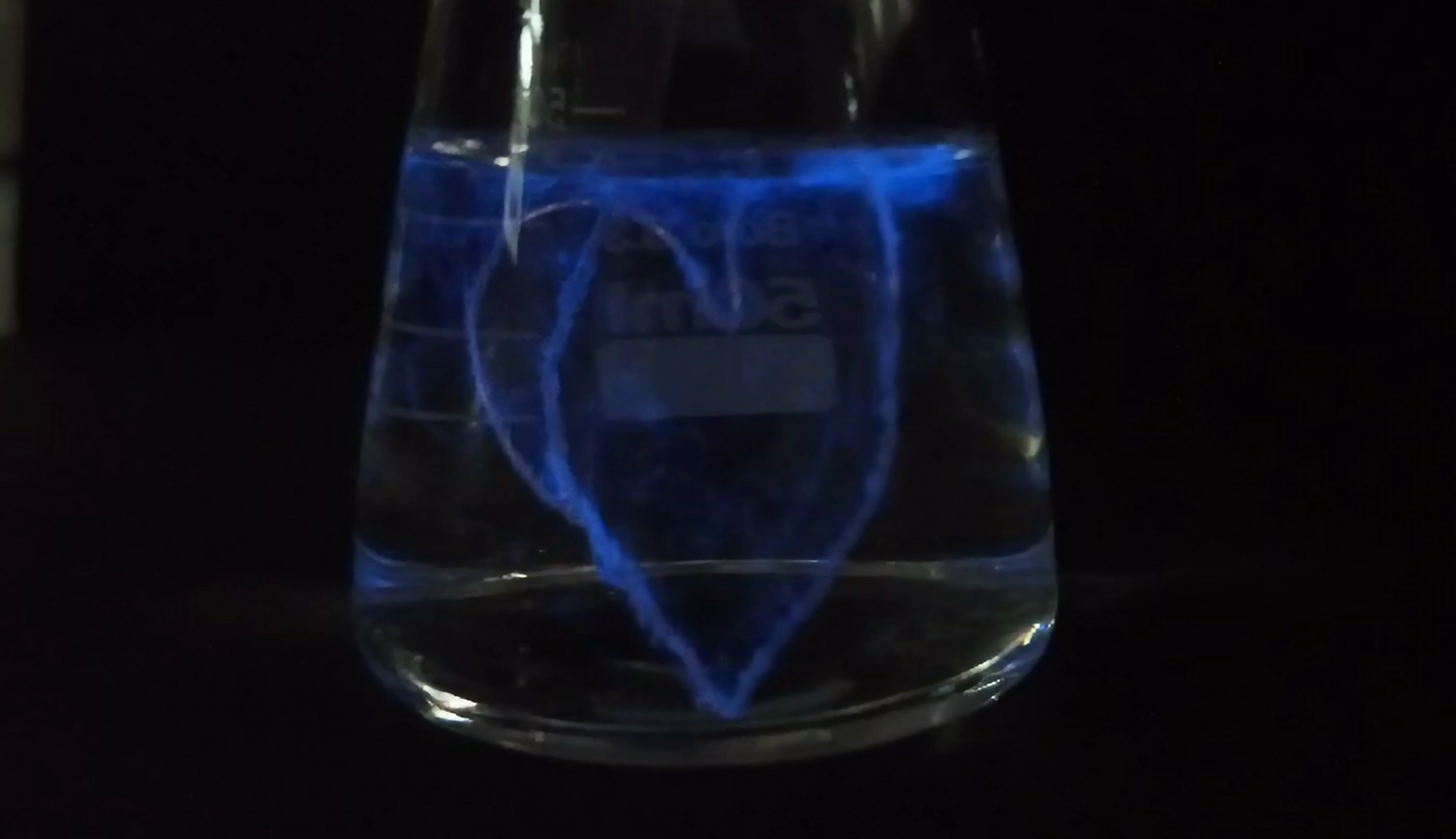
Copper cations (Cu2+) are another excellent catalyst for decomposing hydrogen peroxide, and are a tad cleaner to use than blood or urine. If we took a heart-shaped piece of copper and dipped it into our potion, the Cu2+ ions would relatively homogeneously mix into it, creating a stunning visual effect as the solution glows everywhere (pictured below). However, the homogeneous glow would render the heart shape invisible.
But don’t worry, I still have another trick up my sleeve! It’s called EDTA, short for Ethylenediaminetetraacetic acid (now that’s a mouthful!). This acid is a chelating agent, meaning it can form a dative bond with a single metal cation (such as our Cu2+) via two or more of its atoms, effectively sequestering the cation and preventing it from reacting with other substances (such as hydrogen peroxide). This chelation process is pictured below. M can represent any metal cation, but in our case, it’s Cu2+.
We added EDTA to our initial luminol solution, as it would act as a cage that traps rogue copper cations escaping from our heart-shaped wire, which would otherwise catalyse the decomposition of hydrogen peroxide, thereby eclipsing our heart’s glow.
Romance is the solution
Finally, after combining the two solutions, we can use a heart-shaped copper wire to catalyse the reaction and see the light only on its surface.
We also experimented with a regular coiled copper wire to see the effect more prominently. As we stirred the solution, the oxygen gas and copper ions dissolved, causing all the luminol to glow, and thereby achieving a higher overall brightness.
Being ardently enamoured by and fiercely hating something are inextricably linked insofar as their nature of intense devotion and dedication. They are two sides of the same coin. Akin to luminol’s light, this intensity of our character is a beacon that guides us through the dark void of absurdity inherent to our existence. Hence, we constantly face a decision: what will we choose to give meaning and light to every day we wake up? Will it be blood spilt with the hatchet of hate, or a heart pumped by the vehemence of love?
I prefer the latter: the ephemeral nature of existence unavoidably compels the self to live and act in the best way possible, and to my mind, that is through love and passion. Dislike and opposition to specific ideas are an integral part of an authentic being. Hate, though… hate demands an insurmountable devotion that one cannot afford to be stolen from where it rightfully belongs.
Life is brief. Luminol is limited in solution. Why choose hate?
All extractions I do are for mere educational purposes to learn about phytochemistry. No alkaloids were completely isolated, and the solutions containing them were disposed of after seeing their fluorescence. This website DOES NOT encourage alkaloid consumption or extraction, and STRONGLY ADVISES each viewer to consult their local restrictions before doing any experiment.
Personal Introduction
Ever since my grandfather gave me a mushroom book when I was around five years old, I have been very, very, intensely passionate about nature. What started with learning how to differentiate a Boletus from an Agaricus mushroom has grown into knowing a plethora of scientific names and travelling hundreds of kilometres to see an endangered plant. Parallel to this, ever since I realised I had hands, I have been joining atoms with my molecular model kit and inventing molecules too big to fit on an A4 sheet of paper. Here, I share with you one of the many testaments to my passion as a witness to the most fundamental characteristic of science: living in a perpetual cycle of melting and recasting to be at peace with each new truth unveiled from nature.
Extracting a molecule from the seeds of a desert-dwelling plant that’s both fluorescent and psychoactive? Is it a tale? NO! It’s reality.
Today, you will learn a bit more about the incredible romance between plants and chemistry alongside my journey as a paparazzi that adores documenting every one of their secret encounters. Embrace yourself for me to take you on this (quite literally) intoxicating love story. You may want to skip the extraction part, as it is tedious and dull (though it is written to maintain scientific rigour), and proceed to the“The Moment of Truth…” heading.
Peganum harmala, also known as Syrian Rue, is a herbaceous perennial plant from the family Nitrariaceae, native to the Mediterranean region and extending eastward to Central Asia. It inhabits saline, dry, and disturbed areas, even those that have been subject to eutrophication. It has been used to make traditional medicines, dyes, and incense, among others.
Like the caapi vine, Banisteriopsis caapi, Syrian rue contains a relatively high concentration of alkaloids from the β-carboline class, including harmine, harmaline, and harmalol. Some of these alkaloids are Monoamine Oxidase Inhibitors (MAOI) and therefore prevent our body’s enzymes (Monoamine Oxidases) from degrading hallucinogens like N,N-Dimethyltryptamine (DMT), making its effects stronger.
Last year, I was paging through articles on Google Scholar to find a research topic for a school task. I was left utterly dumbfounded when I discovered that harmaline and harmine are fluorescent, and what’s more, that I could easily extract these compounds myself in the lab. My school wasn’t impressed. Little did they know that a few months later, I would still do the extraction anyway.
And here begins the hunt…
Hunt
Is there anything more magical than the existence, the spontaneously arisen existence, of life? Stellar and supernova nucleosynthesis (the fusion of lighter nuclei to yield heavier nuclei) gave rise to almost all of Earth’s elements, including the soil’s nutrients, the air’s carbon, and water’s oxygen and hydrogen. Nuclear fusion (of hydrogen atoms to give helium) in the Sun powers almost all of life on Earth, which definitely includes ours. Plants, like artists of the atom, utilise enzymes to combine the Sun’s energy and Earth’s elements, creating a vast array of chemical masterpieces, such as our beloved harmaline and harmine.
Nuclear fusion reaction that occurs in the Sun. Image by Doctor C (Own work) [CC BY-SA 4.0], via Wikimedia Commons.
Consequently, I wanted to do everything from scratch to really admire the beauty of evolution. First, I visited a scrubland area in southern Madrid, where the plant had been spotted on iNaturalist. I went in shorts (clever me), offering ticks a free buffet and thistles a chance to paint my legs red, all to find not a single plant. With a sliver of hope, I travelled almost 200km to a town named Molina de Aragón in Guadalajara, Spain, where there was an iNaturalist observation of this plant, hoping to get seeds… and guess what?
Site of observation of Peganum harmala, with views of beautiful Molina de Aragón, Guadalajara, Spain.
Not a plant. Again, all my effort scrambling through chest-high vegetation (not pictured) was absolutely futile.
School was ending soon, and hence, my access to the laboratory. I urgently needed the seeds to carry out the extraction. I had no other choice but to buy them online.
Extraction
Grinding and defatting
The first step is grinding the seeds. This was done with a mortar and pestle. Then, they were defatted using pure n-hexane, CH3(CH2)4CH3, as it is a very apolar molecule due to the small electronegativity difference between carbon and hydrogen.
The seed and n-hexane mixture was stirred and then filtered. The filtrate containing the n-hexane was discarded, and the seeds were left to dry.
Acid-base extraction
The now-defatted seeds were placed in a dilute solution of acetic acid (CH3COOH), the main acid in vinegar, to increase the solubility of the alkaloids in water. The reaction mechanism is shown below in my own drawing of harmine’s protonation. The nitrogen in harmaline and harmine’s pyrrole accepts a proton (H+) with its lone pair of electrons, becoming positively charged and increasing the molecule’s solubility in water, a polar solvent.
Neutral harmine on the left and positively charged harmine on the right. Own drawing.
The mixture was then filtered. The residue (seeds) was discarded, and the filtrate was collected. This part contained all the desired alkaloids in their salt form. Now, using the opposite process, by increasing the pH to around 9 with sodium carbonate (Na2CO3), the acidic salts are converted to our desired harmine and harmaline-free bases (the neutral form of the alkaloid, such as the widely known cocaine freebase!). All of this was monitored using a pH meter, which measures the concentration of protons (H+) in solution using electrical conductivity.
Adjusting the pH of solution using acetic acid and sodium carbonate, keeping track of it with a pH meter. Own video.
Organic solvent extraction
The freebase harmine and harmaline solution was poured into a separatory funnel. Ethyl acetate, which is a less polar solvent than water, was added to get the relatively nonpolar alkaloids to migrate to this organic solvent. The two layers were mixed thoroughly and then left to separate. The aqueous and organic layers were separated and stored separately.
The moment of truth…
Like a kid impatient to open a present on a Christmas morning, I couldn’t wait to see if I really had extracted any alkaloids, and even more, I was anxious to see their fluorescence, which requires ultraviolet (UV) light of around 300nm.
I shone an old UV torch I found hidden in some old drawer on each of the solutions (organic and aqueous), but due to the brightness of the room and the visible light the torch was emitting, I couldn’t see any effect. Fortunately, months before, I had spent countless afternoons on a very special instrument working on my school chemical investigation: the mighty spectrophotometer. This instrument generates light of a discrete wavelength and passes it through a sample, measuring the amount of light absorbed. Water, which is (almost perfectly) transparent, for example, would absorb 0% of light at 500nm (greenish-blue).
I could programme it to pass ultraviolet light (I used 365nm) through my sample, and if I saw ANY LIGHT coming from it, then that’d imply fluorescence, as UV light is invisible to our human eyes. My molecule would be converting UV light to visible light!
I switched on the spectrophotometer. I had to wait 20 very long minutes for it to heat up (it uses a deuterium lamp to generate UV light). As an effort to make the laboratory as dark as possible, I took a poster of a scientific project I had presented at a conference with my friend (see the silver mirror post) and stuck it to a window that the blinds didn’t cover. I closed all the doors and switched off every single light, except the one of hope inside me.
Then, I placed my samples, one cuvette with the organic extract and another with the aqueous extract, inside the spectrophotometer, set the wavelength to 365nm, covered myself and the samples with a lab coat, and…
Fluorescence of harmaline/harmine extraction solution in quartz cuvette. Own image.
IT WORKED!
This minuscule speck of light my sample was re-emitting exhilarated me. This confirmed the presence of harmaline and/or harmine in the solution.
In that moment of ecstasy, I threw away the aqueous solution (which supposedly had no alkaloids) and bottled the organic one to keep it as a souvenir of my experiment. However, after this, I realised that only the aqueous solution fluoresced (probably due to an inadequate pH adjustment and a poor freebase conversion). I had thrown away all the alkaloids I had just spent hours extracting… luckily, I had no intention of using them.
Scientific Explanation
Harmine and harmaline fluorescence under UV light. Image by Coaster420, Public Domain, Wikipedia Commons.
A compound, depending on its chemical structure and therefore its molecular orbitals, may absorb photons of a specific, discrete energy, which is related to its frequency by Planck’s equation:
E=hv Where E is the energy, h is Planck’s constant, and v is the frequency of the light.
When a molecule absorbs a photon, it becomes excited, and the conformation of the molecular orbitals changes (some become antibonding, for example). When fluorescence occurs, the excited electron does not change its spin when it is promoted to higher levels and stays in a singlet state, denoted S, which means that all electrons are paired and hence that the net spin angular momentum is 0. The ground singlet state is designated as S0, and the excited states are labelled as S1, S2, S3, and so on.
Non-fluorescent molecules, when excited, return to their ground state via nonradiative transition, whereby the energy is released not as light, but usually as heat. On the other hand, fluorescent molecules, despite generally undergoing nonradiative transitions from higher excited states (S2, S3…) to the lowest excited state (S1), dorelease a photon when returning from S1 to their ground state (S0), as can be seen in the subsequent Jablonski diagram. As a side note, phosphorescence, a related but distinct phenomenon, is excluded from this discussion to keep it simple.
Jablonski diagram of fluorescence. The levels of excited states and levels of ground states are represented as subsets of the excited state (S1) and ground state (S0), differently from how I am referring to them in this article. Image by Jacobkhed at Wikipedia Commons.
As our fluorescent molecules (harmine and harmaline) lose some of the energy they absorbed via nonradiative transition, the photon emitted during fluorescence is of lower energy and frequency (and hence of longer wavelength) than the one absorbed. This phenomenon is known as the Stokes shift, which explains why I could see the light my sample was emitting, which falls within the visible range (380nm to 750nm), rather than in the UV range (100nm to 400nm), like the photons that excited my sample in the spectrophotometer.
Stokes shift. Image by CactiStaccingCrane – Own work, CC BY 4.0, Wikipedia Commons.
Conclusion
The minute speck of light that my sample emitted was a testament to something often overlooked in our quotidian lives: the truly incredible predictive power of Science. Owing to the invisible effort of a myriad of scientists and philosophers who laid (and lay) the foundation for our understanding of the world, we can know a fact so seemingly simple yet truly complex at heart (quantum mechanics, molecular biology, neuroscience, chemistry): that a plant’s chemical is psychoactive and will fluoresce under UV light.
Nature, like the peak of a towering mountain hidden by clouds, is perpetually enshrouded by an essence of change. In its never-ending chase, Science unveils fragments of its rugged terrain and shows us that even though the admirer and the admired do not share a synallagmatic contract, sometimes Nature does delight us with a glimmer of hope that we might know something of the intimidating cosmos we inhabit. —Own
Don’t believe that an atmospheric-dwelling and life-giving gas can disinter hues from the underworld!? Just watch pool chlorine and hydrogen peroxide mix!
Today, I’m sharing the story of a straightforward yet breathtaking scientific experiment I conducted, which lies at the interface between chemistry and quantum mechanics: the chemiluminescence of singlet oxygen.
Summarised Reaction
Anything that glows is magical. No matter how omnipresent light is in our lives, it never ceases to fascinate our human curiosity. Consequently, if I combine it with chemistry in a fun reaction, then I’ll always be eager to try it out.
The simplicity of this reaction that gave bright red light enticed me: I only needed trichloroisocyanuric acid (TCCA, its abbreviation, (CONCl)3, its formula) and 30% hydrogen peroxide (H2O2) to produce chemiluminescent singlet oxygen. TCCA can be found in many supermarkets as a pool cleaner. 30% Hydrogen peroxide can only be found in authorised laboratories, due to its danger as a strong oxidant.
Trichloroisocyanuric acid reacts with water to give cyanuric acid ((CNOH)3) and hypochlorous acid (HOCl).
Then, the hypochlorous acid dissociates to give the hypochlorite ion (–OCl), which reacts with hydrogen peroxide to produce singlet oxygen (1O2). Chlorine gas arises from a few other reactions that aren’t relevant to the production of singlet oxygen.
My friend Máximo and I gathered both compounds and devised a perfect setup. As very toxic (used in WW1) chlorine (Cl2) gas is released, a fume hood is sine qua non for living on to learn more chemistry.
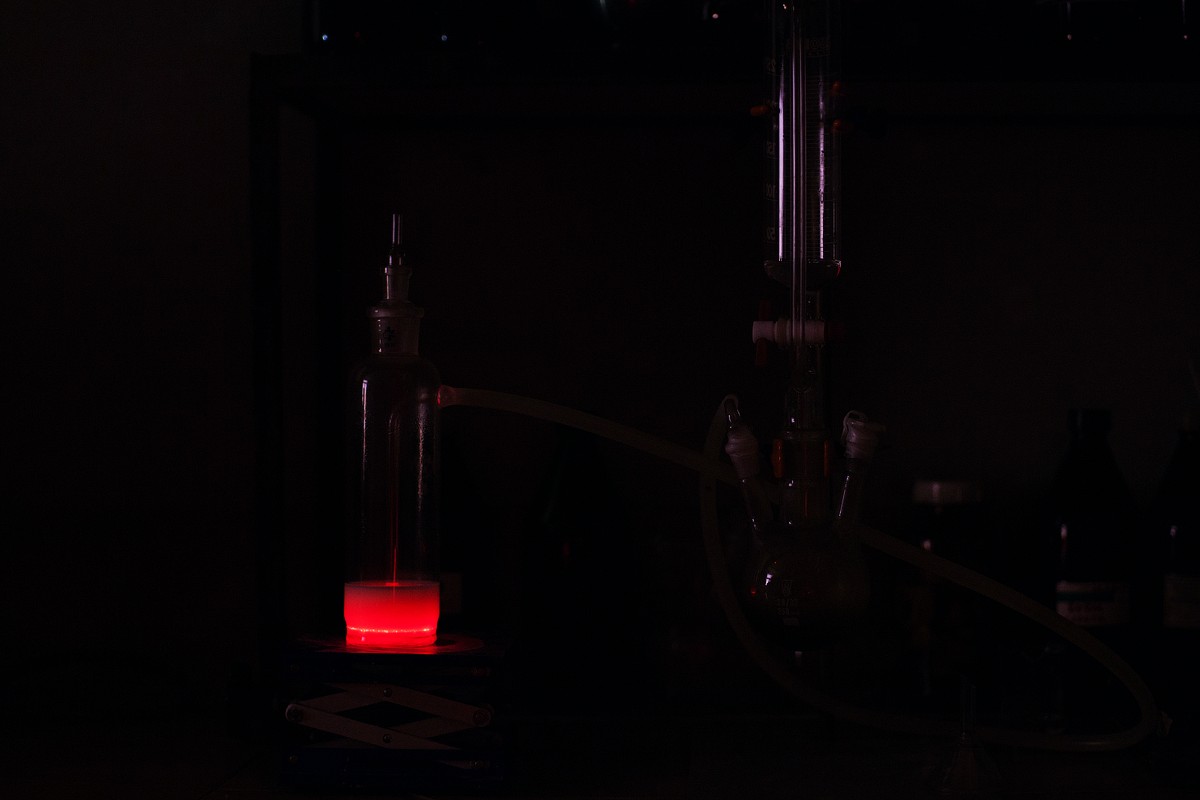
We covered the fume hood with posters to make it as dark as possible. We then made a hole in the posters to manoeuvre a beaker containing TCCA, allowing us to drop it into the hydrogen peroxide without having to open the fume hood, which would let ambient light in (and put our lives at risk, which might be more valuable than achieving pitch darkness). We set up the filming equipment and started the reaction. In the first trial, attempting to neutralise the chlorine gas with sodium hydroxide (NaOH), the solution splattered everywhere and left corrosion stains (still present today) on my computer, so we switched to a protected phone camera for filming. Here is a video of our beautiful production of chemiluminescent singlet oxygen.
Scientific explanation of singlet oxygen chemiluminescence
Gas from the heavens
Oxygen is one of the most essential elements for life, and is the third most abundant element in the universe. At standard temperature and pressure (273.15 K and 105 Pa), oxygen generally exists as the allotrope dioxygen (O2).
The ground (most stable, low energy) state of dioxygen is the spin tripletstate, denoted 3Σg–. The image below shows the molecular orbital diagram for this spin state.
What is characteristic of triplet oxygen is that the two non-bonding electrons of the molecule areeach in a different antibonding π orbital (one in πx* and one in πy*) and have the same spin (represented with arrow direction), conferring extra stability.
As a consequence of the aligned spins, triplet oxygen is paramagnetic (forms internal, induced magnetic fields in the direction of the applied magnetic field), as can be seen in the image below.
Paramagnetic property of triplet oxygen best observed in liquid state. Adapted image. By Bob Burk, work supported by the National Science Foundation under grant numbers: 1246120, 1525057, and 1413739 – [1], frame at 4:26, CC BY 3.0, https://commons.wikimedia.org/w/index.php?curid=57047554
Singlet state
The other spin state oxygen can exist in that is relevant to this experiment is the lowest excitedsinglet state, denoted 1Δg, which is higher in energy than the triplet state, 3Σg–. When oxygen is in its singlet state, it will react much more readily with other singlet molecules than when it’s in the triplet state.
In 1Δg, the two aforementioned non-bonding electrons are in the same antibonding π orbital (either πx* or πy*), and hence have opposite spins, following the Pauli exclusion principle.
When two molecules of singlet oxygen collide, they “deactivate” by exchanging their non-bonding electrons, producing two molecules of triplet oxygen (two molecules of 3O2) and LIGHT, due to the energy difference between singlet and triplet oxygen. In the image caption, there is a link to a video which explains it really well.
Deactivation reaction for two molecules of singlet oxygen. Image is a screenshot taken from a video of Random Experiments Int. – Experiments and Syntheses, which can be found at: https://www.youtube.com/watch?v=XDYAzdEhOGc. Permission was very kindly expressely given by the author.
Above, 1O2 and 3O2 represent singlet and triplet oxygen, respectively. The arrows show the spins of the electrons in the antibonding pi orbitals.
This chemiluminescent process is known as dimol emission. The reason why two molecules of singlet oxygen are needed to collide and exchange electrons is that the non-bonding electrons in each molecule of singlet oxygen CANNOT change their spin to occupy the other antibonding pi orbital, as is the configuration in the triplet state.
Using Plack’s equation, we can deduce the wavelength (λ) of the emitted light knowing the energy released (E), Planck’s constant (h) and the speed of light (c).
The energy difference between triplet oxygen, 3Σg–, and singlet oxygen, 1Δg, is 94290 J mol-1. As two molecules (not moles!) of singlet oxygen are combined to form two molecules of triplet oxygen, we must first divide the energy by Avogadro’s number (6.02·1023 mol-1) and then multiply by 2 giving a total release of 3.13·10-19 J per collision. Multiplying Planck’s constant times the speed of light and dividing by the energy provides the wavelength in metres, so it is multiplied by 109 to convert it to nanometres.
The emitted light, with a wavelength of around 634nm, corresponds to the red part of the visible light spectrum, which is precisely how we observe it in the experiment.