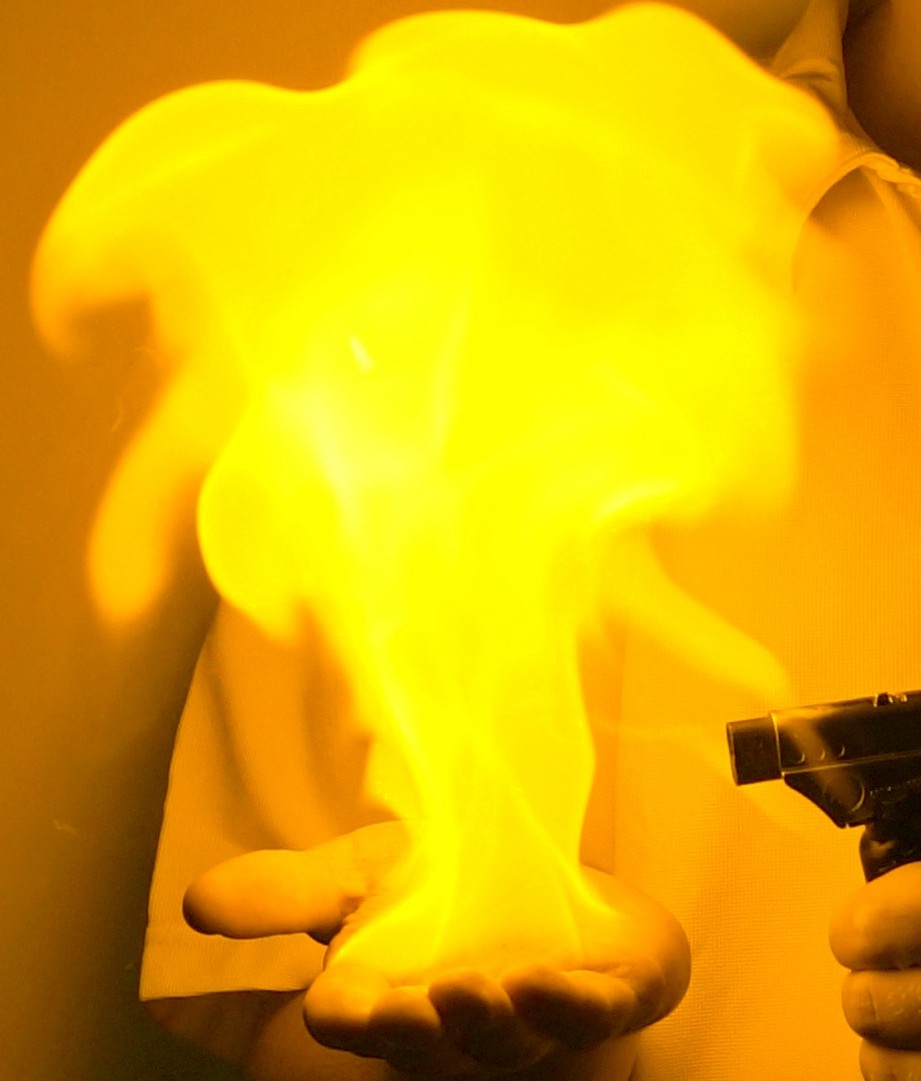
I went up on stage. For a moment of suspense that seemed like ages, I rummaged through my pockets and took out a lighter and a string of nitrocellulose pieces stuck with vaseline. As a surprise for the over 300 people in front of me, I ignited it, causing it to burn fiercely. After the few seconds it took to become ashes, I said: “¡Esta es la vida!” (meaning “This is life!” in Spanish). That’s how I started my Baccalaureate graduation speech on the fleetingness of life.
The nitrocellulose I used was made from scratch by my friend Máximo and me. Until the moment of the graduation speech, absolutely no one but myself knew what I was going to use that nitrocellulose for. However, because of my reputation at school as a chemistry enthusiast, after burning the magic paper on stage, many figured that I had synthesised it.
A towering polymer
Cellulose, the most abundant organic polymer on Earth, is a fundamental building block of green plants’ cell walls, as well as algae and oomycetes. The image below perfectly showcases the synergistic power of polymers. This banana species, Musa ingens, native to montane New Guinea, is herbaceous, i.e. non-woody, and thus its very tall stem is mostly built with cellulose, not lignin.

Cellulose is a polysaccharide made of chains of β-glucose (C6H10O5) joined by 1-4 bonds (from carbon 1 to carbon 4), as shown in the image below.

Usually, cellulose burns relatively slowly, requiring an external oxidiser such as diatomic oxygen present in the air (O2) to combust. However, if we replace the hydrogen (H) in the hydroxyl groups (OH) with a nitro group (R-NO2), we can make a nitrate ester (R-ONO2). The NO2 in the nitrocellulose is highly oxidative and thus accelerates combustion, as now it doesn’t depend on the oxygen present in the air.
Nitroxylation on paper
The process of converting cellulose to nitrocellulose, often wrongly called nitration, is denominated nitroxylation, as what is being formed is not a nitro compound (R-NO2), but a nitrate ester (R-ONO2). The mechanism can be seen below.

To carry out the pictured reaction, nitric acid (HNO3) is used as a “nitrating agent”, and sulphuric acid (H2SO4) as a catalyst, being an excellent proton (H+) donor.
Nitroxylation of paper
After understanding the chemical reactions involved and reading the procedure and safety precautions, my friend and I went to the lab in a flash.
In two beakers, we added some 96% sulphuric acid, which is so viscous you could trick someone into thinking it’s mineral oil. Then, to experiment, instead of using nitric acid directly, we added potassium nitrate (KNO3) that would react with the sulphuric acid to make nitric acid and potassium sulphate (K2SO4). In one beaker we added folded paper towels and in the other, pure cotton. We left it to soak and nitroxylate for around 2 hours.

Afterwards, using a glass rod, we took both the paper towel and cotton out and put them in an alkaline solution of sodium hydroxide (NaOH), to neutralise any remaining acid. The two beakers still containing sulphuric and nitric acid were also neutralised with sodium hydroxide until a pH of 7 was reached (tested with pH strips). Following this, the solutions, now only containing innocuous salts, were washed down the drain. It is of paramount importance to make sure chemical waste is properly disposed of to avoid the slightest harm to the environment. How stupid would it be to destroy our beautiful World, the source of our awe!

The now-nitrocellulose was then washed and placed in a food dehydrator to dry.

Watch it burn
After doing my last exam, the afternoon before my graduation day, I tested the nitrocellulose, and it worked wonders for the effect I wanted! The cotton one got more nitroxylated, probably due to a higher initial cellulose purity.
Leave a Reply